Tuesday, October 18, 2005

The New Chancellor

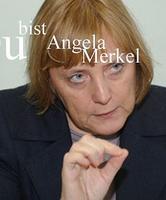
InstaPLANET presents Angela Merkel, the new German Chancellor
The wait is over: Germany has a new Chancellor who will soon be turning the "executive men's-room" into the "executive powder-room" ...

.

After weeks of negotiations following the German Federal Election of September 18, 2005 the two main opposing parties, SPD and CDU/CSU, entered into a Grand Coalition in order to make up the required majority of seats in the Bundestag. The two parties reached an agreement whereby the CDU/CSU candidate, Angela Merkel, will succeed Gerhard Schröder in the office of Chancellor and the SPD will fill 8 of a total of 16 ministerial posts. Merkel is the first woman ever to hold the position of German Chancellor.

Angela Dorothea Merkel (born July 17, 1954) grew up in the communist GDR (the former East Germany). She graduated with a doctorate in physics. In 1989, after the fall of the Berlin Wall, she entered the political arena, aided by her mentor Helmut Kohl. Her political career culminated, 13 years later, in her election to chairwoman of the Christian Democratic Party (CDU) and leader of the conservative opposition in the lower house of the German Parliament (Bundestag) under former Chancellor Schröder.


It remains to be seen, over the coming months, what course she will steer in German national and international policy and, by extension, in the future of the EU (European Union), of which Germany is a powerful and influential member.

.

We want to hear YOUR Opinion : Please click on the 'COMMENTS'/'Post a Comment' Link below:

Labels: , , , , , , ,

0 comment(s) so far - Click here to leave your feedback: We want to hear from you

Monday, October 03, 2005

15 Jahre Deutsche Einheit - German Reunification

InstaPLANET Germany Update

October 3, 1990: - After more than 40 years, East and West Germany, which had been separated by different political systems in the aftermath of World War II, were peacefully reunited. The fall of the Berlin Wall was the symbol of the reunification of the two countries under a democratic system. On October 3, 1990, East Germany was dissolved and its citizens became citizens of the Federal Republic of Germany.

Excerpts from 'A Message from the President of the Federal Republic of Germany on the Day of German Unity 2005':

"On 3 October the Germans are celebrating the 15th anniversary of national unity in freedom. ... One and a half decades have passed and we have achieved much thanks to the drive and solidarity of Germans in east and west. ... There are new roads, railway lines and modern telecommunication networks. ... Internationally acclaimed centres for science and technology have sprung up. ... But we also know that many problems still remain to be solved. The most pressing is the problem of the millions of unemployed – in the new Länder but also all across . At the same time, we have to deal with the aging of our society. These are major tasks for policy-makers yet these tasks have been identified and the process of renewal has begun. ..."

.

AMALGAMATED PERSPECTIVES Editorial Comment: - October 3, 2005. - Even after 15 years of efforts toward economic integration Germany has a long road to travel in mending the social polarization between East and West. To this day, the East is still unable to survive without government subsidies amounting to some €70 to €80 billion a year. Major long-term structural reforms are needed to bring about social, political and economic equalization. The concept of 'One Germany' is still far from having been made a reality in the lives of its population. -

.

[See also: Bundestagswahl 2005 - Elections in Germany ]

.

Labels: , , , ,

0 comment(s) so far - Click here to leave your feedback: We want to hear from you

Friday, September 23, 2005

- Bundestagswahl 2005 - Elections in Germany

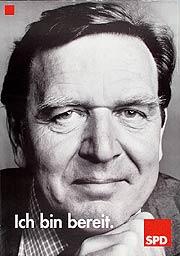
Gerhard Fritz Kurt Schröder
On September 18, 2005, the 16th Bundestags (federal) election (since 1949) was held in Germany in order to establish the Bundeskanzler (Chancellor) and his or her Cabinet, who will be directing the course of national and international German politics and policies for a term of 4 years. In this special election, which was called by the Bundespräsident to be held 17 months prior to the end of the regular four year cycle, seven distinctive political parties were on the ballot and 77.7 percent of all eligible voters participated.


In a bitter fight of rhetoric and ideology the two major rival parties, the SPD as embodied by Gerhard Schröder, and the opposition party CDU as represented by Angela Merkel, had vied for the mandate of the German voter. The outcome, in percent of votes cast, is as follows:
The Social Democratic Party SPD 34.3% - the right-of-center Christian Party CDU 27.8% - the CDU-affiliated CSU 7.4% - the Green Party 8.1% - the classical liberal FDP 9.8% - The Leftists 8.7% - and miscellaneous fringe parties 3.8%.


In accordance with German Parliamentary law, in cases where no single party has a majority on its own, a coalition government must be formed. At present rumors abound as to which party the CDU/CSU will choose for their coalition partner. This choice will affect the appointments to all government posts, and will dictate the political platform of German national and international policy. As of now, this momentous decision has not been made.


Germany, along with Great Britain and France, is a powerful member of the EU (European Union) and, by extension, the German heads of government will exert significant influence on global issues. The formation of the new German government will be a strong indicator of the future role Germany will play on the World Stage.


Meanwhile, AMALGAMATED PERSPECTIVES encourages you to seek out European and International media resources in order to stay informed on global issues, as we find the American media coverage of international events to be minimal, simplistic and all too often biased.
.


[See also: Bundesrepublik Deutschland - a Federal Representative Democracy]
.

[Read the Follow-up Article: "Whois the German Chancellor?"]


.

Labels: , ,

0 comment(s) so far - Click here to leave your feedback: We want to hear from you